
What to Do If Your Shipment Arrives Damaged

Vetrina windows and doors are custom-manufactured for each project and should be inspected carefully as soon as they arrive. If you notice shipping damage, missing components, or another discrepancy, documenting the condition correctly at the time of delivery is important.
The most important rule is simple: inspect the shipment before the carrier leaves whenever possible.
Vetrina instructs customers and installers to compare the shipment against the packing list, approved order, and project documentation before signing the delivery receipt. Visible damage, shortages, or discrepancies should be written on the delivery receipt and photographed at that time.
Inspect the Shipment Before Signing
Do not assume that a wrapped or crated shipment is undamaged simply because the outside packaging appears intact.
Before signing for the delivery, visually inspect the accessible units and packaging for signs of impact or handling damage. Check that the number of units received corresponds with the shipment documentation and that the unit identification matches your project.
Where accessible, inspect the frames, sashes, corners, joints, glass, gaskets, finishes, hardware, and separately packaged accessories. Vetrina's receiving procedure also recommends operating accessible sashes through their intended positions to confirm that the hardware functions properly before the delivery receipt is signed.
If You See Damage, Note It on the Delivery Receipt
If any damage is visible, do not sign the delivery receipt as though the shipment arrived without exception.
Describe the damage or shortage on the carrier's delivery receipt before signing it.
The notation should be specific enough to establish what was observed. For example:
Crate damaged at lower-right corner; aluminum frame inside visibly dented.
or:
One glass unit visibly cracked upon delivery.
or:
Shipment received with one unit missing.
Avoid unnecessarily vague descriptions when you can identify the affected item more precisely.
Photograph the Damage Before the Carrier Leaves
Take clear photographs before the shipment is moved or unpacked further whenever practical.
You want the photos to establish both what is damaged and how the shipment arrived.
A good damage record should include the overall shipment, the affected crate or unit, close-up photographs of the damage, the product or unit identification where available, and the delivery receipt showing your damage notation.
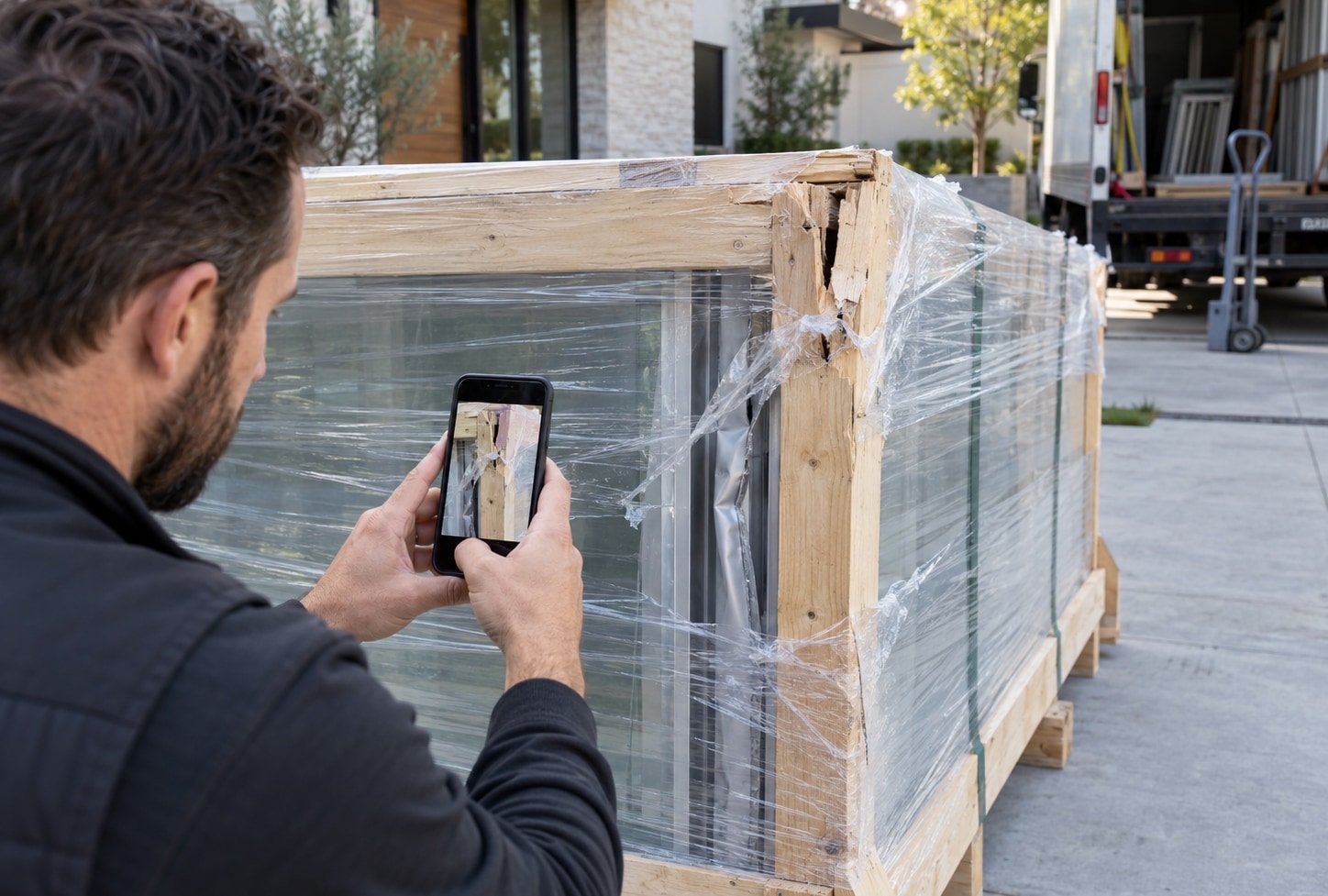
Vetrina specifically requires photographic documentation of damage or discrepancies along with the noted delivery receipt.
Check More Than Just the Frame
Shipping damage is not always limited to scratches or dents.
Look carefully for cracked or chipped glass, damaged glass edges, bent or deformed profiles, damaged corners or joints, displaced gaskets, scratched finishes, damaged handles or hardware, and missing accessories.
Our receiving procedure calls for inspecting insulating glass units for cracks, chips, edge damage, internal condensation, or other visible signs of seal failure. If one portion of a crate shows evidence of significant impact, inspect the units around that area particularly carefully.
Verify That Nothing Is Missing
Damage and shortages should be treated with the same attention during receiving.
Compare the shipment with the packing list and approved project information. Confirm the total number of units as well as the identification, configuration, and handing of the products received.
Also verify that project-specific accessories such as sills, trim pieces, anchors, brackets, gaskets, fasteners, or other separately packaged components are present and undamaged where they are part of the shipment.
Report the Problem to Vetrina Within 48 Hours
Vetrina requires shortages, discrepancies, and shipping damage to be reported within 48 hours of delivery, together with clear photographic documentation.
Contact Vetrina as soon as possible rather than waiting until installation begins.
When reporting the issue, include your project or order information, the affected unit or position number if available, a description of the damage, photographs of the damaged area and surrounding shipment, and a photograph or copy of the delivery receipt showing the damage notation.
Providing complete information from the beginning allows our team to identify the affected product and review the issue more efficiently.
Do Not Install a Damaged Unit
If a window or door has visible shipping damage, do not install it unless Vetrina has specifically authorized you to proceed.
The installation guide states that damaged units should not be installed and work should not proceed with missing components unless authorized in writing by Vetrina Windows.
This is particularly important when the damage affects glass, frame geometry, hardware, corners, joints, or another component that could affect the unit's operation or performance.
Installing a damaged unit can also make it more difficult to determine whether a condition occurred during transportation or during subsequent handling and installation.
What If the Damage Seems Minor?
Photograph and report it anyway if you are uncertain.
A small scratch in a noncritical location may ultimately be cosmetic, while seemingly minor deformation near a corner, locking point, roller, glass edge, or frame joint can potentially affect operation.
Do not attempt to straighten, touch up, disassemble, or repair the affected area before Vetrina has had an opportunity to review the documentation.
Store the Unit Safely While the Issue Is Reviewed
If the damaged unit will remain on site while the issue is being evaluated, keep it properly supported and protected.
Vetrina recommends storing units upright on stable, padded supports at least 3" above the ground, as close to vertical as practical, and no more than approximately 10 degrees from vertical. Units should be kept in a clean, dry, ventilated area protected from moisture, construction debris, impact, direct sunlight, and excessive heat.
Do not place other construction materials against the product or allow loads to rest on the frame, glass, sash, mullions, or hardware.
What Happens After You Report the Damage?
Vetrina will review the information you provide to identify the affected product and determine the appropriate next steps.
Depending on the type and extent of damage, additional photographs, measurements, product information, or other documentation may be requested before a resolution can be determined.
Do not make repairs or modifications unless instructed to do so.
Quick Damage-Reporting Checklist
Before the delivery driver leaves, whenever possible:
Inspect the shipment and count the units.
Compare unit identification with the packing list and approved order.
Inspect frames, glass, finishes, hardware, and accessories.
Photograph any damage or shortage.
Write the damage or discrepancy on the delivery receipt before signing.
Keep a copy or photograph of the signed receipt.
Report the issue to Vetrina within 48 hours.
Do not install the damaged unit unless authorized by Vetrina.
Need Help?
If your Vetrina shipment arrives damaged or incomplete, contact Vetrina Windows as soon as possible with your project or order information, affected unit number, description of the issue, photographs, and delivery receipt.
Clear documentation taken at the time of delivery helps our team review the issue and determine the appropriate next steps as quickly as possible.