
Diagnosing Common Swing Door Operating Issues
Applies to: Millennium Series glass and panel swing door systems.
A properly installed aluminum swing door should move through its full opening arc without binding, return to the closed position predictably, latch without excessive pressure, and engage its locking hardware without lifting, pushing, or pulling the sash into position.
When one of those conditions changes, the most useful approach is to determine whether the source is door geometry, hinge position, locking alignment, closer adjustment, or access-control hardware before attempting a correction.
This guide addresses the operating conditions most frequently associated with hinged aluminum entrance doors and explains what to inspect before requesting service.
Begin With the Door Geometry
Before adjusting locks or closers, examine the relationship between the door sash and the surrounding frame.
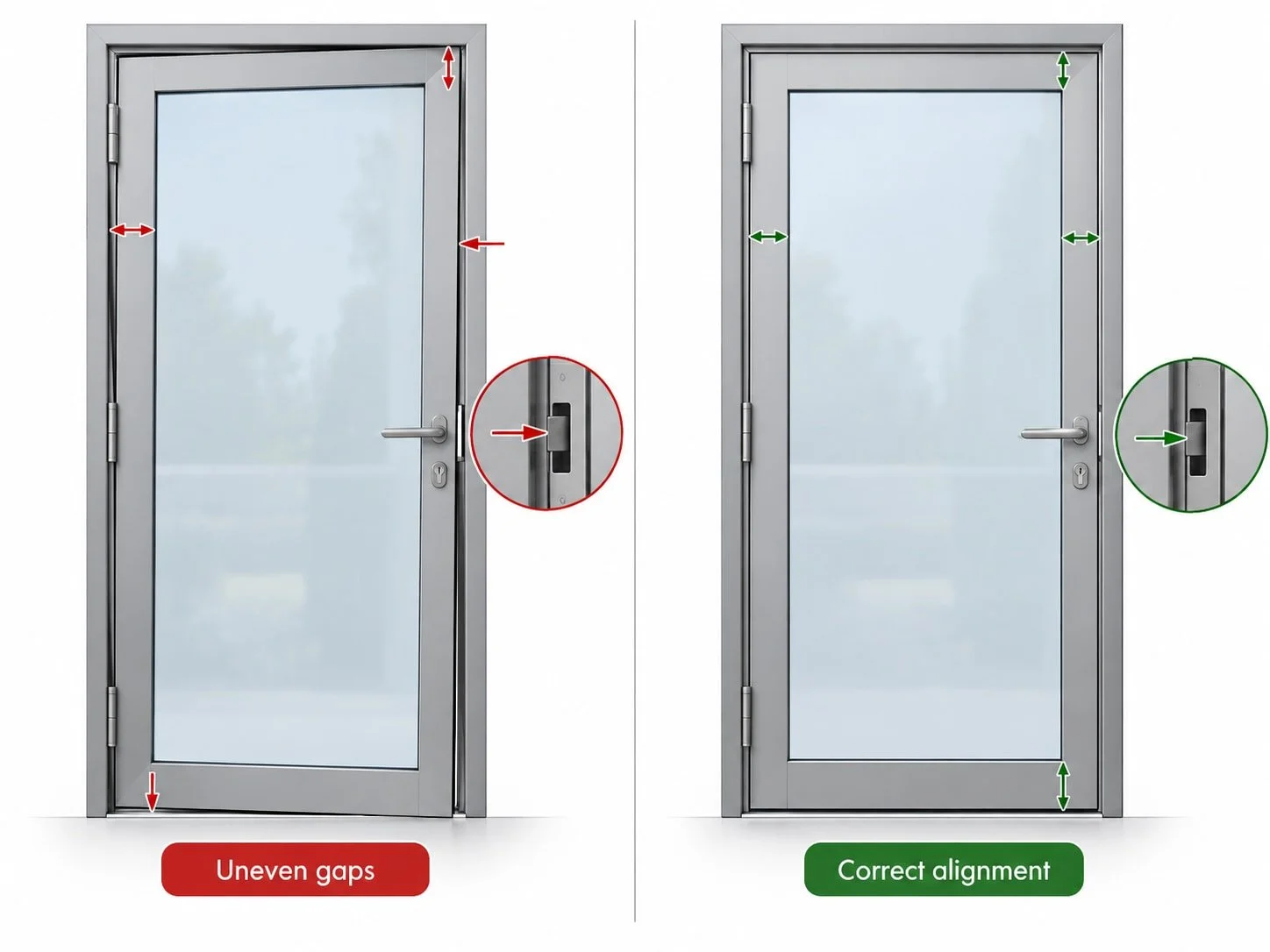
Slowly open and close the door while watching the clearance around the perimeter. A correctly aligned sash should maintain a reasonably consistent reveal and should not make contact with the sill, head, or jamb during normal operation.
Pay particular attention to:
The clearance at the upper latch-side corner
The bottom edge of the sash
The gap along the hinge side
The relationship between the latch and its strike
Whether the door must be physically repositioned before it will lock
Frame geometry is fundamental to door operation. Vetrina's installation guidance requires the frame to be accurately leveled and plumb and specifically cautions against allowing loads from the surrounding structure to bear on the door system. Frame distortion can alter sash movement and locking alignment, even when the hardware itself is functioning correctly.
For that reason, significant operating problems should not be corrected solely by moving hinges or strikes until the frame condition has been verified.
When the Sash Rubs, Drags, or No Longer Sits Evenly
A door that begins contacting the frame or threshold is typically showing a change in sash position. The location of the interference is useful diagnostically:
If the sash drags at the lower latch-side corner, it may have settled vertically.
If it contacts the upper latch-side corner, the sash may require lateral correction.
If the door appears centered but requires excessive pressure to close, the issue may involve closing pressure rather than height or lateral position.
On configurations equipped with adjustable concealed hinges, the hardware provides separate adjustments for:
Vertical position – raises or lowers the sash.
Horizontal position – shifts the sash laterally relative to the frame.
Closing pressure – alters how firmly the sash compresses against the frame and gaskets.
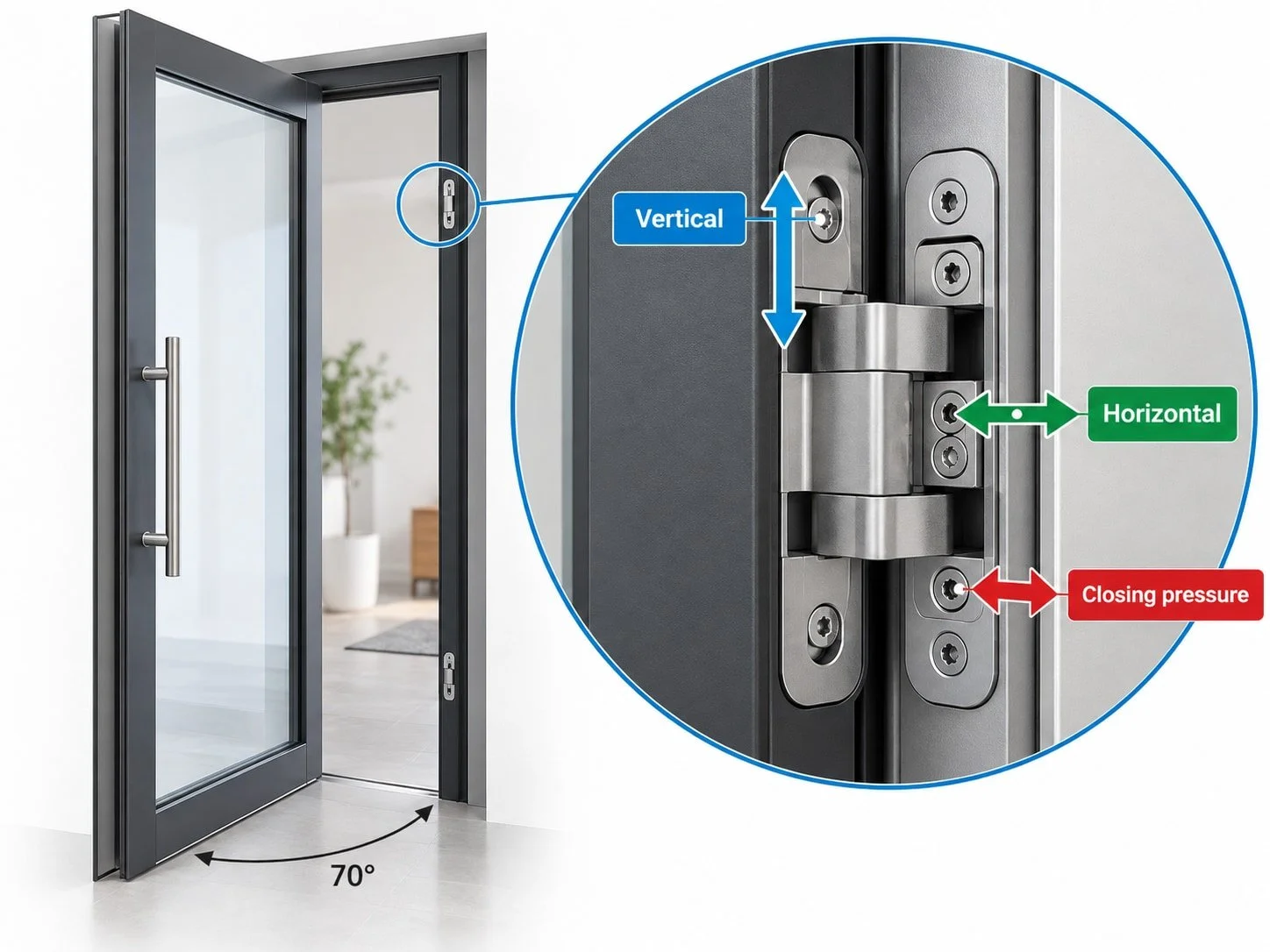
Our hardware documentation provides approximately ±4 mm of vertical and horizontal correction, together with a smaller range of pressure adjustment. Concealed hinges should be adjusted consistently rather than correcting only one hinge in isolation.
These adjustment ranges are intended to refine an otherwise correctly installed door. They should not be used to compensate for substantial frame distortion or structural movement.
If the Door Appears to Have Settled
A door that operated normally when first installed but later begins dragging is often described as having "dropped."
The visible symptom is usually a change in the reveal around the sash. The handle-side bottom corner may sit closer to the threshold, while the opposite upper corner shows a larger clearance.
Minor settlement can often be corrected at the hinge adjustment.
However, if the same condition repeatedly returns, further investigation is warranted. Check the frame for level, plumb, fastening integrity, and support.
Our engineers recommend controlled fixing locations, proper alignment, and using shims where necessary so the frame remains correctly positioned during fastening. Our installation detail also recommends approximately 1/4" shimming where required to establish proper alignment.
A door that continually requires hinge correction may indicate an installation or substrate issue rather than a hinge problem
When the Door Reaches the Frame but Does Not Latch Cleanly
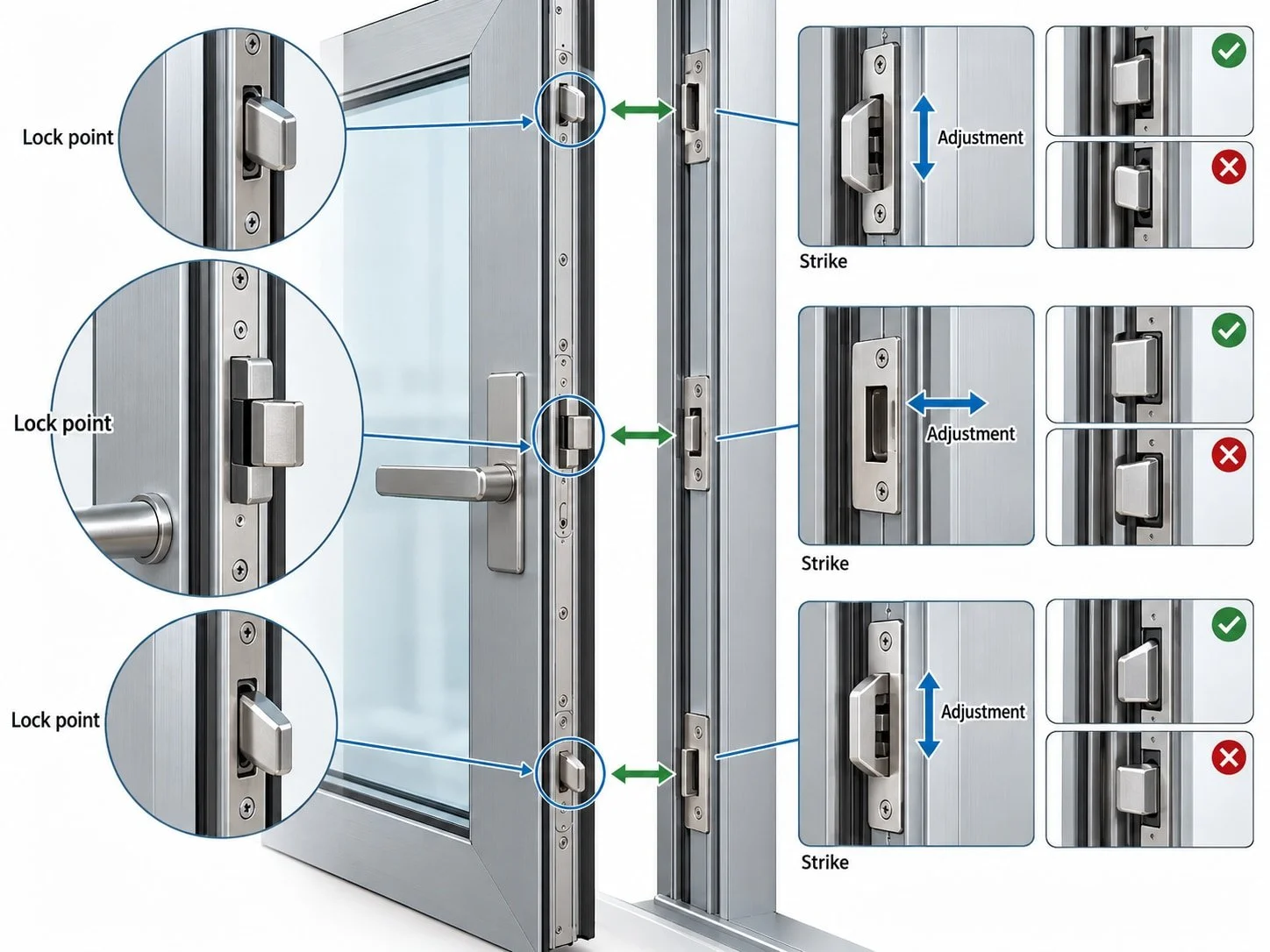
If the sash closes but the latch contacts the strike instead of entering it smoothly, compare the latch height and position with the strike opening.
A misaligned strike often produces very specific symptoms:
The latch strikes the top or bottom edge of the opening
The door latches only when pushed firmly
Pulling or lifting the sash slightly allows it to latch
The latch operates normally when the sash is manually held in a different position
The swing-door hardware documentation provides adjustment at the strike locations. Depending on the locking arrangement, the central strike allows approximately ±2 mm of adjustment, while additional strikes may provide approximately ±1.6 mm.
That adjustment is intended for fine alignment.
If the latch and strike are separated by more than a minor amount, correct the sash position or frame geometry before substantially relocating the strike.
A Stiff Handle Is Usually a Symptom, Not the Diagnosis
When a lever becomes difficult to move, the natural assumption is often that the lock is failing. In practice, increased handle effort can also result from the locking points being forced against misaligned strikes.
A useful diagnostic is to operate the handle with the door open.
The handle operates normally with the door open
This strongly suggests that the internal locking mechanism is capable of operating and that resistance occurs when the sash enters the frame.
Inspect:
Locking-point alignment
Strike position
Sash height
Sash lateral position
Closing pressure
Handle remains stiff with the door open
Resistance that remains with the sash completely clear of the frame points more directly toward the handle, gearbox, lock mechanism, or connecting hardware.
In either condition, avoid increasing force on the lever. A misalignment problem can become a damaged-hardware problem if the handle is repeatedly forced.
Understanding Handle-Operated Multipoint Locks
Some Vetrina swing doors use a multipoint locking arrangement in which the lever and key perform different functions.
The hardware documentation describes a sequence in which raising the lever activates the multipoint locking mechanism, while turning the key operates the central deadbolt and locks the handle.
That distinction is important during troubleshooting.
If the door is closed and the lever will not lift into its normal locking position, repeatedly turning the key will not correct a misaligned upper or lower locking point. Instead, determine whether the sash is fully seated and whether each locking point aligns with its corresponding strike.
If the lever operates normally with the door open but becomes difficult only when the door is closed, alignment should be investigated before the lock is assumed to be defective.
When the Key Turns but the Door Still Does Not Lock Correctly
On handle-operated multipoint systems, the key is not intended to substitute for operation of the lever.
The lever first positions the multipoint locking elements. The cylinder then secures the mechanism through the central deadbolt and handle lock.
If the door must be pushed, pulled, or lifted before the lever can be raised, the issue is more likely related to geometry or strike alignment than to the cylinder itself.
This is why testing the locking mechanism with the door open is such a useful first diagnostic step.
Electronic Release or Intercom Will Not Open the Door
Where an electric strike or intercom release is installed, always verify the mechanical lock condition before troubleshooting the electrical system.
The hardware documentation notes that on applicable configurations, locking the door with the cylinder disables the intercom-controlled release.
If an electronically controlled door suddenly stops releasing:
Confirm that the cylinder has not been mechanically deadlocked.
Return the lock to its normal electrically releasable condition.
Test the release again.
If the system still does not respond, inspection can then move to the electrical side, including the strike, power supply, wiring, contacts, or access-control equipment. For electronic locking systems that use sash-to-frame contacts, the technical documentation also calls for keeping the contact surfaces on the frame clean.
Oxidation, dirt, construction dust, or poor contact at these points can affect electrically operated hardware.
Diagnosing Door-Closer Problems
A door closer introduces a separate set of operating variables from the hinges and lock.
Typical symptoms include:
Door closes too aggressively
Door takes too long to close
Door closes most of the way but does not latch
Door requires excessive effort to open
Hold-open or retention behavior is incorrect
The manufacturer's closer instructions provide separate adjustments for closing speed, final closing stroke, retention point, and release force.
Those functions should be diagnosed individually.
Door slams through most of its travel
The primary closing speed may be set too high.
Door closes normally but stops before the latch engages
The final closing stroke may require correction, provided the sash and latch are already properly aligned.
Door has become unusually difficult to open
Closer force may be excessive. Excessive release force can place damaging loads on the hinges and closer fastening points.
Do not compensate for a misaligned latch by simply increasing closer force. Correct the alignment first.
Excessive Gasket Compression
A swing door can be perfectly level yet still feel unusually tight as it enters the frame.
When that happens, check gasket compression and the hinge-side closing-pressure adjustment.
Adjustable concealed hinges provide a dedicated pressure setting intended to control how firmly the sash seats against the frame. The correct setting should provide consistent gasket contact without requiring unnecessary force at the handle.
More compression is not inherently better. Excessive pressure can increase operating resistance, make the lever harder to use, and place additional load on the locking hardware.
Noise, Rough Movement, or Dry Hardware
Not every change in operation requires alignment work.
Construction dust, airborne debris, and ordinary service conditions can accumulate in the hinge, gasket, and locking areas and create rough or noisy operation.
Our maintenance guidance recommends cleaning the spaces between the sash, frame, and gaskets with a vacuum or soft brush and lubricating friction components such as hinges, handles, locks, and other moving mechanisms. Repeat this lubrication approximately every six months after the initial application.
Use lubricant only on the intended moving components and avoid overspray onto finished aluminum, glass, or surrounding construction.
Distinguishing an Installation Issue From a Service Issue
The problem's history can be as informative as the symptom itself.
A door that never operated correctly should prompt an installation review.
A door that operated correctly for months or years and then changed gradually is more likely to involve maintenance, adjustment, wear, or building movement.
For a door with persistent operational problems from the outset, verify:
Frame level
Frame plumb
Squareness
Consistent perimeter clearance
Shimming
Fastening
Structural pressure on the frame
Hardware should be the final adjustment layer of a correctly installed system, not the mechanism used to compensate for an incorrectly positioned frame.

Conditions That Require Further Technical Review
Owner-level troubleshooting should generally stop once the issue moves beyond cleaning, observation, or a clearly identified minor adjustment.
Further service is appropriate when:
The sash visibly sags or contacts the frame
More than a minor hinge correction appears necessary
The door repeatedly moves out of adjustment
The multipoint mechanism binds even while the door is open
A hinge, strike, lock, or closer is visibly damaged
The door frame appears distorted
Electronic release remains inoperative after verifying the cylinder position
The closer leaks or behaves erratically
Operating the door requires substantial force
Avoid drilling the frame, relocating hardware outside its adjustment range, dismantling concealed hinges, or modifying locking and access-control components without confirming the applicable procedure.
Information to Send Vetrina for Technical Support
For a swing-door operating issue, the fastest diagnosis usually comes from a combination of overall photos and a short operating video.
Please include:
Project or order information
Door location or position number
Whether the door opens inward or outward
A full photo of the closed door
A clear view of the hinge side
Close-ups of the latch and strike
Close-ups of the handle and lock
Photos showing the perimeter gaps around the sash
A video showing the complete open-close-lock cycle
For locking problems, it is especially helpful to record the handle and locking mechanism once with the door open and once with it closed.
That comparison often immediately distinguishes a lock-mechanism problem from an alignment problem.