
Understanding Vetrina Window & Door Hardware
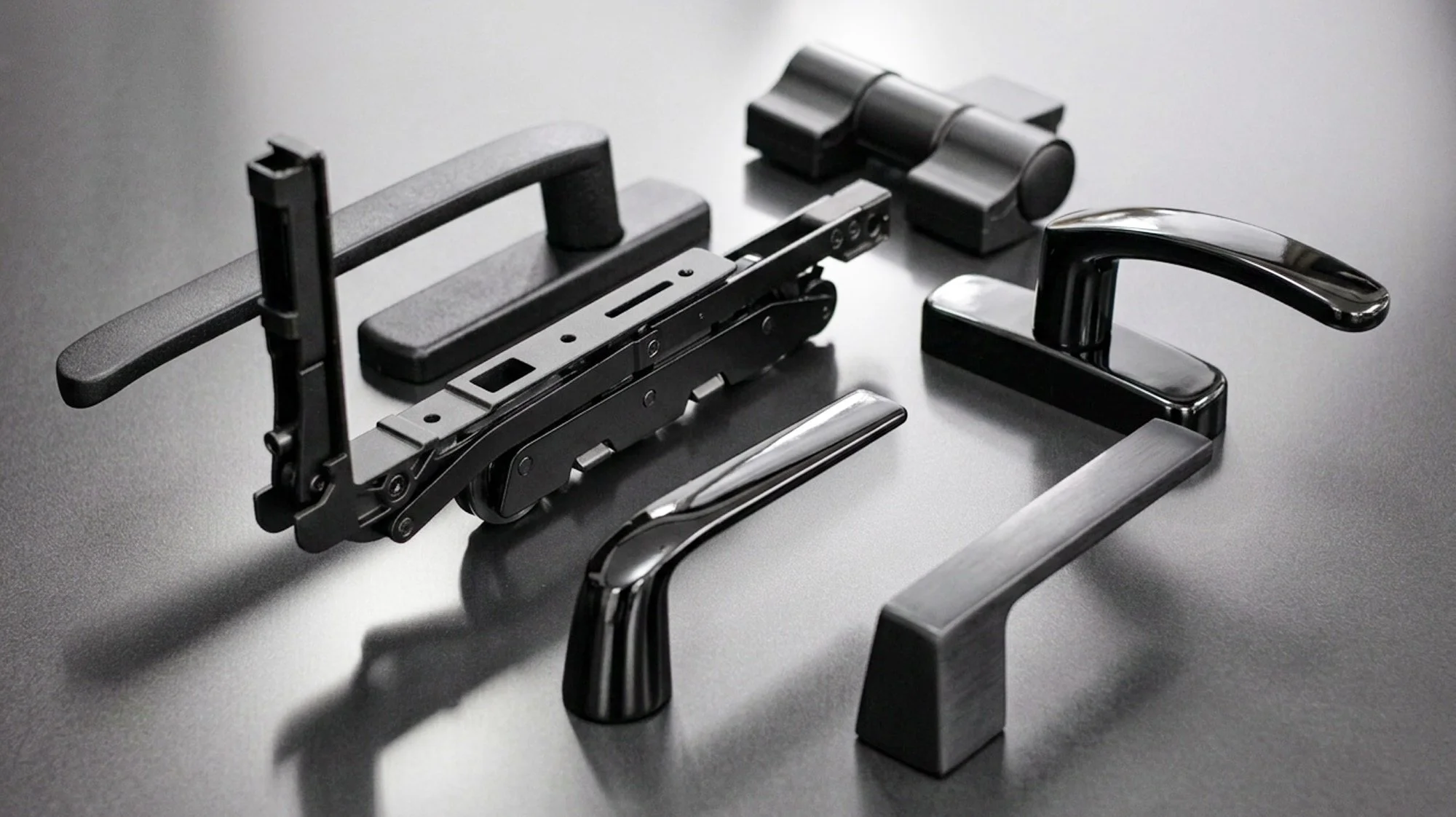
Hardware is one of the most technically important parts of a window or door assembly. Handles, locking points, hinges, rollers, stays, cylinders, and other components do much more than provide a way to open the product. They determine how the sash operates, how loads are transferred through the system, how the unit locks, and, in some configurations, how security or emergency-egress functions are achieved.
For this reason, Vetrina hardware is selected as part of the complete window or door system, rather than simply by appearance.
Two handles that look similar may operate entirely different mechanisms or use different mounting dimensions, spindles, locking functions, or handing. When selecting new hardware or identifying a replacement component, the product type and internal mechanism are therefore just as important as the visible handle.
Hardware Starts With the Type of Opening
The first consideration is how the window or door operates.
A tilt-and-turn window, lift-slide door, tilt-slide sash, bi-fold system, and swing entrance door all place different demands on their hardware.
The hardware must be able to control the movement of the sash while accommodating its size and weight. On large tilt-and-slide systems, for example, dedicated hardware packages are selected according to sash dimensions and weight. Our hardware selection is vast and includes configurations engineered for sashes ranging up to 200 kg, with the operating handle integrated into a larger system of carriages, stay arms, closing components, and safety devices.
This is why hardware should not be treated as a universal accessory that can be freely substituted between product types.
Window Handles: The Handle Is Part of the Locking System
On an operable window, the visible handle is generally connected to a transmission mechanism that operates locking points around the sash.
Depending on the configuration, the hardware may control:
Standard casement operation
Tilt-and-turn operation
Tilt-before-turn operation
Multipoint locking
Microventilation
Opening restriction
Enhanced-security locking
Lockable window handles are also available where additional access control or security is required. Vetrina specifically recommends keyed handles for security configurations and includes handles designed to work with both transmission-box and multipoint mechanisms.
The handle therefore cannot always be replaced simply because another handle fits the same visual style.
Tilt-Before-Turn and Standard Tilt-and-Turn Hardware
Some window configurations use conventional tilt-and-turn operation, while others use tilt-before-turn, sometimes referred to in European technical documentation as "logical operation."
With tilt-before-turn hardware, the operating sequence is intentionally arranged so that the ventilation position is accessed before the full swing-open position. Depending on the application, this can be useful where controlled ventilation is desirable while unrestricted opening should be less immediately accessible.
The security documentation supports hardware configurations for both conventional tilt-and-turn and tilt-before-turn arrangements.
Because the internal operating sequence differs, the appropriate handle and hardware package must match the actual configuration of the window.
Hardware for Large Sliding and Lift-Slide Doors
Large sliding systems require a different approach.
The handle must provide sufficient leverage and ergonomics to operate a much larger sash while remaining visually appropriate for narrow contemporary aluminum profiles.
The Atria documentation, for example, describes pull handles specifically developed for elevating/sliding systems and designed to make large and heavy sashes easier to maneuver. The range includes conventional pull handles, versions incorporating a lock, and recessed finger pulls.
These types of components may also be combined according to the function of each panel. A primary operating panel may use a substantial pull handle, while the opposite face or an adjacent panel may require a low-profile finger pull.
Available hardware can also be coordinated with the architectural finish. The documentation includes multiple combinations, keyed and non-keyed versions, and the ability to finish applicable handles in RAL colors.
Tilt-Slide Hardware Does More Than Slide
Tilt-slide systems are a useful example of why the handle should be considered part of the mechanism rather than a decorative component.
Depending on the configuration, these systems can use standard manual handles or longer handles that assist with the more complex opening sequence.
Some configurations also incorporate an incorrect-operation safety device. The documentation describes a device that prevents the operating handle from being actuated while the sash is already in the open sliding position, helping protect the hardware from improper operation. It can also prevent the sash from lifting unintentionally.
In other words, the handle, carriage system, stays, locking components, and safety devices operate as one coordinated assembly.
Bi-Fold Door Handles Require Special Clearance
Bi-fold doors introduce another important hardware constraint: the panels stack closely together.
An intermediate locking handle cannot project excessively when the panels are folded, or it may contact and damage the neighboring panel.
The bi-fold handle documentation supplied to Vetrina specifically describes a low-profile handle designed so that its operating end does not extend beyond its own width when rotated, helping prevent interference with the opposite panel during stacking.
That handle is also designed around specific mechanical interfaces, including a 7 mm drive spindle and 43 mm screw centers.
This illustrates why a replacement bi-fold handle should be identified by more than its appearance.
A handle that looks nearly identical may have the wrong:
Spindle size
Screw spacing
Backplate
Cylinder provision
Projection
Operating direction
Any of these differences can make the replacement incompatible.
Swing Door Handles, Pulls, and Locking Functions
Swing entrance doors offer one of the widest ranges of hardware because the appropriate handle depends heavily on the selected lock.
Vetrina's available hardware documentation includes single-sided and double-sided lever handles, pull handles, exterior knobs, cylinders, multipoint locking, electronic release hardware, emergency-exit hardware, and panic hardware.
The lock configuration determines which operating hardware is appropriate.
For example, the swing-door technical documentation notes that with certain automatic locks, an exterior knob or pull handle is recommended rather than an exterior lever. By contrast, a handle-operated multipoint lock requires a double-handle configuration so the mechanism can be operated from both sides.
This is a good example of why the handle selection cannot be separated from the lock selection.
Single-Point and Multipoint Locking
A single-point lock secures the sash primarily at one central locking location.
A multipoint system connects the operating hardware to additional locking points positioned along the sash.
Depending on the application, multipoint systems can improve compression and distribute locking engagement around a larger portion of the opening.
Security-oriented window hardware can go significantly further. The EVO Security documentation uses mushroom-shaped security cams, adjustable locking elements, and combinations of intermediate and terminal locking points. Certain configurations can incorporate as many as 14 locking points.
However, the number of locking points should not be considered in isolation.
The same documentation specifically notes that a certified security configuration must be evaluated together with the glazing and the window system in which the hardware is installed.
That distinction is important. Security performance belongs to the complete assembly, not simply to one handle or lock.
Locking Pressure Is an Adjustment, Not a Security Upgrade
Some locking hardware incorporates eccentric or adjustable cams that allow the compression between the sash and frame to be fine-tuned.
This adjustment is primarily used to achieve correct operation and gasket compression.
Tightening a locking point beyond what is required does not automatically make the window more secure. Excessive compression can instead make the handle difficult to operate and unnecessarily increase loads on the hardware and seals.
The objective is a correctly adjusted system in which the locking points engage securely while the handle continues to operate smoothly.
Lockable Handles and Access Control
A keyed handle can provide an additional layer of control by preventing normal operation of the handle without the key.
On certain security-window configurations, this is specifically recommended because preventing handle manipulation is part of the overall hardware strategy.
Swing doors may use a different approach, including cylinders, automatic locks, electronic strikes, intercom release, or access-control hardware.
Emergency and public-access doors may require dedicated emergency-exit or panic hardware instead of conventional residential-style locking. The swing-door documentation includes both emergency-exit and panic-bar configurations, including systems with multiple locking points.
The correct hardware therefore depends not only on the door itself, but also on how the opening is intended to function.
Hardware Appearance and Finish
Hardware is highly visible, so aesthetics remain an important part of the selection process.
Available Vetrina configurations can include:
Black
White
Silver finishes
Stainless-steel appearance
Powder-coated finishes
Project-specific colors
RAL-coordinated finishes
Stainless-steel handle families
The supplied documentation includes multiple swing-door lever styles and finishes, as well as dedicated stainless-steel handle families for windows and doors.
The goal is typically to coordinate the hardware with the frame finish and overall architectural intent without compromising the operating requirements of the system.
Why Replacement Handles Are Not Always Interchangeable
When an existing handle is damaged, it is tempting to search for a replacement based on appearance alone.
That can easily result in the wrong component.
Before selecting a replacement, several characteristics may need to be verified:
Product type
Opening type
Interior or exterior location
Left- or right-hand orientation
Spindle dimensions
Screw-center spacing
Locking mechanism
Cylinder or escutcheon configuration
Backplate dimensions
Handle projection
Finish
Whether the hardware operates a single or multipoint mechanism
For specialized products, even clearance when the door is folded or stacked can determine whether a handle is suitable. The bi-fold hardware documentation is a good example: its handle geometry is specifically designed to remain within the required panel clearance during stacking.
If You Need a Replacement Handle or Hardware Part
The fastest way for Vetrina to identify replacement hardware is usually to work from the original project information and clear photographs rather than from a verbal description alone.
When requesting a replacement, provide:
Project name or order information
Window or door position number, if available
Product type
Photo of the complete window or door
Close-up photo of the hardware
Photo with the handle in more than one operating position
Interior and exterior views where applicable
Photo of any visible manufacturer markings
Finish or color
Description of what is damaged or no longer operating correctly
If the component has already been removed, include photographs of the back of the handle, spindle, mounting holes, and connecting hardware.
Do not discard the original component until the replacement has been confirmed.
Maintaining Window and Door Hardware
Hardware performs best when moving components remain clean and correctly lubricated.
The supplied swing-door maintenance documentation recommends removing dust and foreign material from the sash and frame areas and lubricating friction components such as hinges, handles, locks, and other moving mechanisms. For that door hardware, the manufacturer recommends repeating the lubrication approximately every six months after the initial application.
Avoid using abrasive cleaners, steel wool, aggressive chemicals, or sharp tools on finished hardware.
If a handle or lock suddenly requires substantially more force than normal, investigate the cause rather than simply adding more lubricant. Increased operating effort may indicate alignment, locking-pressure, or hardware damage that requires adjustment.
Need Help Selecting or Identifying Hardware?
Vetrina can help determine the correct handle, lock, or related component for an existing Vetrina window or door.
Because many hardware components are system-specific, please send photographs and project information before ordering a replacement whenever possible.
Our team can use the original product configuration together with the visible hardware details to determine the appropriate replacement or compatible alternative.